

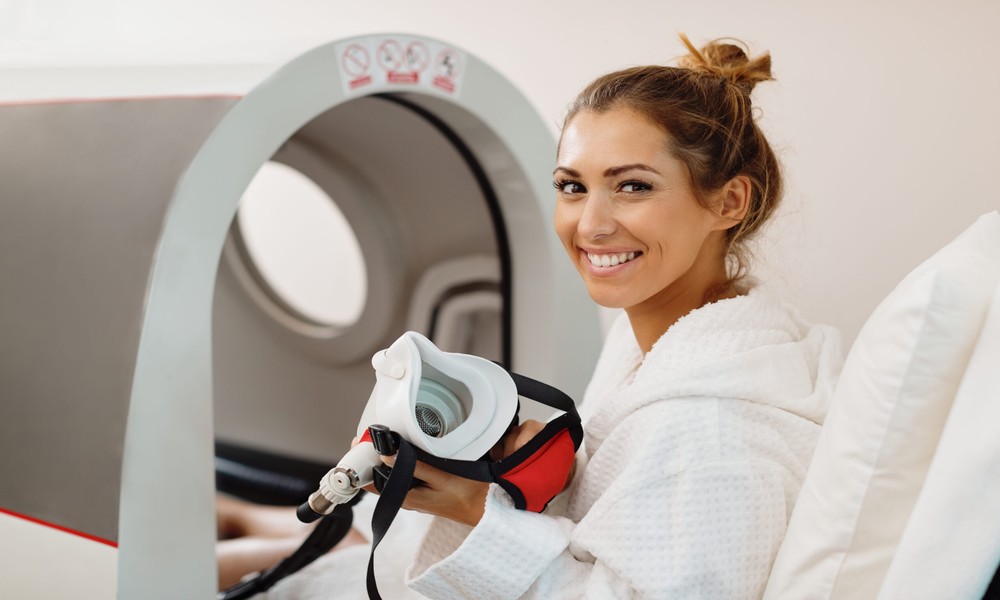
When patients find out that Draper Spinal Care offers hyperbaric oxygen therapy alongside NUCCA chiropractic and spinal decompression, the most common reaction is a raised eyebrow. HBOT is the treatment people associate with wound care centers, burn units, and decompression sickness in divers – not a chiropractic office in southern Salt Lake County. That association isn’t wrong, but it’s incomplete. The clinical applications for hyperbaric oxygen therapy have expanded considerably over the past two decades, and its relevance to the kinds of conditions a spinal care clinic treats daily is more direct than most patients expect.
Understanding why starts with understanding what hyperbaric oxygen actually does inside the body – not at the level of the chamber or the pressure gauge, but at the cellular level where healing either happens or doesn’t.
What HBOT Does That Normal Breathing Cannot
Under normal atmospheric conditions, oxygen is carried through the bloodstream almost entirely by hemoglobin – the protein inside red blood cells that binds oxygen molecules and ferries them to tissues throughout the body. Hemoglobin in a healthy person breathing room air is already close to fully saturated with oxygen. There’s not much capacity left to deliver more through the same mechanism just by breathing deeper or faster.
Hyperbaric oxygen therapy changes the delivery system. By having a patient breathe pure oxygen inside a pressurized chamber – typically at 1.5 to 2.0 atmospheres of pressure for mild hyperbaric applications – the concentration of oxygen dissolved directly into the blood plasma increases dramatically. At 2.0 atmospheres breathing pure oxygen, plasma oxygen levels can rise to ten to fifteen times normal. That oxygen doesn’t need hemoglobin to travel. It dissolves into plasma, cerebrospinal fluid, lymphatic fluid, and synovial fluid, reaching tissues that have compromised circulation or that blood cells physically can’t penetrate in sufficient numbers.
This matters for healing in several ways. Damaged and inflamed tissue is often hypoxic – oxygen-deprived – because inflammation disrupts local circulation and increases metabolic demand simultaneously. Delivering oxygen to hypoxic tissue accelerates the cellular energy production (ATP synthesis via aerobic metabolism) that repair processes depend on. It also triggers angiogenesis – the growth of new capillary blood vessels – in areas where circulation has been chronically reduced, creating lasting improvements in tissue perfusion that outlast the HBOT sessions themselves.
The anti-inflammatory effect is a separate mechanism. Hyperbaric oxygen down-regulates certain pro-inflammatory cytokines and reduces oxidative stress at the cellular level, which is relevant to conditions where chronic, low-grade inflammation is part of what’s perpetuating symptoms long after an initial injury.
Where the Research Is Established and Where It’s Developing
The FDA-cleared indications for hyperbaric oxygen therapy include thirteen specific conditions – among them carbon monoxide poisoning, diabetic foot wounds, radiation tissue damage, severe anemia, and gas gangrene. For these applications, the evidence is strong and the clinical use is well-established.
Beyond those cleared indications, HBOT is being actively studied for a broader range of conditions, and some of those applications are directly relevant to patients who come to a spinal care clinic. Traumatic brain injury and post-concussion syndrome have been the subject of substantial HBOT research, including randomized controlled trials published in journals including PLOS ONE and Frontiers in Neurology, with findings suggesting improvements in cognitive function, headache, and quality of life in patients with persistent post-concussion symptoms. The mechanism makes physiological sense: concussive brain injury creates regions of metabolic dysfunction in tissue that isn’t structurally dead but isn’t functioning normally, and oxygen delivery to those regions appears to support recovery.
Chronic inflammatory conditions – including fibromyalgia, complex regional pain syndrome, and some autoimmune presentations – have shown responsiveness to HBOT in research settings, with the anti-inflammatory and angiogenic mechanisms being the proposed pathways. Wound healing and post-surgical recovery, where revascularization and tissue oxygenation directly determine the pace of repair, are consistent applications.
It’s important to be precise about what the evidence shows at this stage. For the off-label applications, the research is meaningful but the evidence base is smaller and less uniform than for the FDA-cleared indications. That doesn’t make the applications clinically unsupported – it means patients should understand where they’re standing on the evidence spectrum and make decisions accordingly. Draper Spinal Care’s approach is to use HBOT as part of a broader recovery protocol, not as a standalone treatment for conditions with a complex etiology.
Why It Complements Spinal Care in a Way That Makes Clinical Sense
The question of why a chiropractic clinic offers HBOT isn’t really a question about categories – chiropractic versus medicine, structural versus physiological. It’s a question about what patients who come in with chronic spinal conditions actually need to recover fully.
Take a patient with a herniated lumbar disc causing sciatica. Spinal decompression addresses the mechanical compression on the nerve. But the nerve itself, after months or years of compression, may have sustained inflammatory damage that requires its own healing timeline – a timeline that’s largely governed by how much oxygen and nutrient delivery the nerve tissue has access to. HBOT’s ability to saturate plasma with dissolved oxygen, bypassing the circulation limitations in chronically irritated nerve tissue, creates conditions for nerve healing that decompression alone can’t provide.
A whiplash patient presents similarly. The NUCCA correction addresses the atlas misalignment that’s perpetuating upper cervical dysfunction. But whiplash injuries involve soft tissue damage – ligaments, muscles, and intervertebral discs in the cervical spine – that heals slowly when local circulation has been disrupted by the original trauma and subsequent inflammatory response. Accelerating that soft tissue repair through HBOT can shorten recovery time and reduce the residual symptoms that sometimes persist after structural correction.
Post-concussion syndrome is another area of convergence. Many patients with persistent post-concussion symptoms also have upper cervical misalignment from the same impact event – and addressing both the neurological and structural components of their presentation is more effective than treating either in isolation.
The rationale for housing these modalities in the same clinic isn’t incidental. It reflects a treatment philosophy that distinguishes between correcting structural problems and supporting the body’s capacity to heal those problems once they’re corrected. Those are different processes, and they benefit from different tools.
What the Experience Involves
The hyperbaric chamber at Draper Spinal Care is a mild hyperbaric chamber – a soft-sided, pressurized enclosure that the patient enters and reclines in while breathing oxygen through a mask or hood. The chamber is comfortable, well-lit, and designed for patients who may have concerns about enclosed spaces.
Sessions typically run sixty to ninety minutes. The pressurization happens gradually at the start of the session and depressurizes equally gradually at the end. Most patients find the experience quiet and relaxing – many use the time to rest, listen to audio, or simply lie still in a way they rarely get the opportunity to do in daily life.
The number of sessions in a course of treatment varies by condition and the goals of care. Acute post-injury recovery may require a shorter series than chronic inflammatory conditions where tissue perfusion has been compromised over a longer period. For patients using HBOT as part of a combined protocol with NUCCA or decompression, the scheduling is coordinated so the therapies support rather than compete with each other.
There are contraindications to HBOT that are reviewed at consultation – primarily untreated pneumothorax, certain medications that are affected by oxygen metabolism, and some pulmonary conditions. An intake evaluation ensures that HBOT is appropriate for a given patient before treatment begins.
A Note on Mild vs. Hard-Shell Hyperbaric Chambers
Patients who research HBOT will encounter a distinction between mild hyperbaric chambers (typically 1.3 to 1.5 atmospheres, soft-sided) and hard-shell chambers (up to 2.0 to 3.0 atmospheres, rigid construction). The FDA-cleared indications for HBOT are based on research conducted primarily in hard-shell chambers at higher pressures. Mild hyperbaric chambers operate at lower pressure and produce lower plasma oxygen levels than hard-shell units – a clinically relevant difference for some applications.
Most of the off-label research on TBI recovery, chronic inflammation, and post-surgical healing has also been conducted using higher-pressure protocols. The mild HBOT available at wellness and chiropractic settings produces a different, lower physiological oxygen load than the research protocols. This is worth understanding clearly. Mild HBOT is not equivalent to hard-shell HBOT in oxygen delivery, and claims that extrapolate hard-shell research results to mild chamber settings should be read with that distinction in mind.
That said, mild HBOT does produce meaningful increases in plasma oxygen levels compared to breathing room air, and clinical observations among practitioners using mild chambers show patient-reported improvements in energy, recovery from physical stress, inflammatory symptom reduction, and overall well-being. For patients seeking adjunctive support for recovery that sits alongside their structural care, mild HBOT represents a low-risk intervention with physiological plausibility and a growing observational base.
One Clinic, Multiple Tools for a Complex Problem
Chronic pain and spinal conditions don’t resolve through a single intervention in most cases. They respond to a treatment environment where the structural problem is addressed, the body’s healing capacity is supported, and the different dimensions of a patient’s presentation are considered together rather than in isolation.
That’s the logic behind what Draper Spinal Care has built – NUCCA chiropractic for structural upper cervical correction, spinal decompression for discogenic conditions, and hyperbaric oxygen therapy for the physiological environment in which healing occurs. These aren’t unrelated services sharing a waiting room. They’re tools that address different aspects of the same problem.
If you’re managing a chronic spinal condition, recovering from injury, or dealing with neurological or inflammatory symptoms that haven’t fully responded to conventional treatment, HBOT may be worth discussing as part of your care plan. Call Draper Spinal Care at (801) 701-2111 to schedule a consultation and find out whether hyperbaric therapy is appropriate for your situation.
