

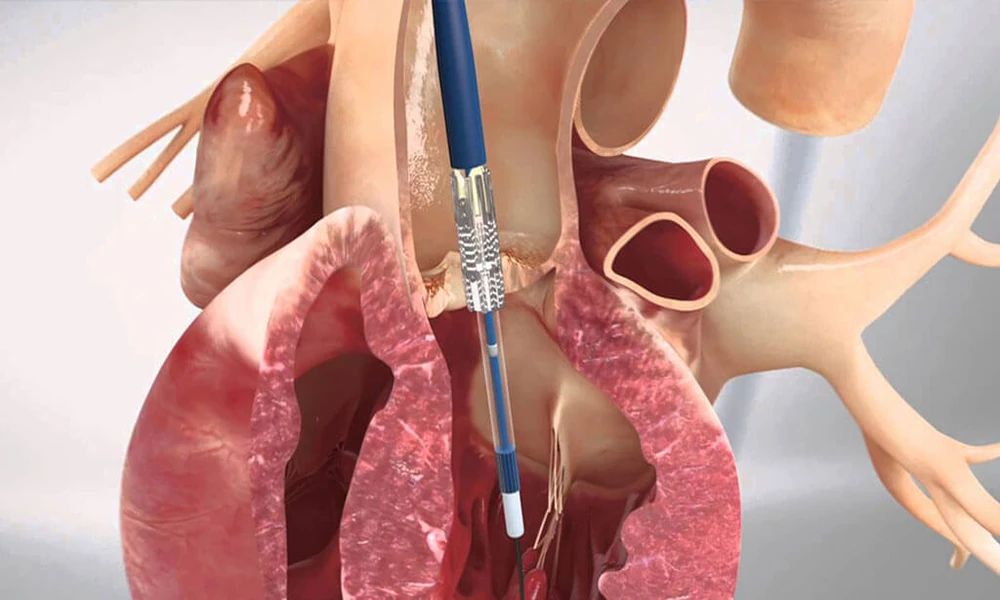
MitraClip is a small clip delivered through a vein in the leg that pinches the two leaflets of a leaking mitral valve together, reducing the leak without open heart surgery. The technique is called transcatheter edge-to-edge repair, or TEER. It is one of the costliest heart procedures available in India, mainly because of the imported device, so patients and families understandably want to know what they are paying for, whether insurance helps and whether the expense is justified for them.
What the procedure involves
Under general anaesthesia and guided by transoesophageal echocardiography, the cardiologist passes a catheter from the femoral vein into the right atrium, crosses into the left atrium through the thin wall between them, and positions the clip on the mitral leaflets at the point of the leak. One or two clips are usually placed. The chest is not opened and the heart keeps beating throughout. Most patients leave hospital within two to four days.
The step-by-step MitraClip procedure is described on the Heart Valve Experts site, and the broader TEER page explains how the technique fits among other mitral treatments, including newer clip systems.
Who is eligible?
TEER is not a replacement for surgery in everyone. It is generally considered for patients with:
- Moderate-to-severe or severe mitral regurgitation with symptoms despite optimal medicines
- High or prohibitive risk for open surgery because of age, frailty, lung disease, kidney disease or previous cardiac surgery
- Suitable valve anatomy on echocardiography: adequate leaflet length, a leak located centrally, a valve opening that is not already narrow
- Either degenerative regurgitation (a floppy or torn leaflet) or functional regurgitation (a leak caused by a weakened, enlarged heart), where surgery offers less benefit
A heart team, including a cardiac surgeon and an echocardiographer, reviews each case. Patients who are good surgical candidates are usually advised to have surgical repair, which remains the standard for degenerative disease in fit patients.
What the cost includes
The estimate for TEER is dominated by the device. A typical package contains:
- The clip system: the clip, its delivery catheter and the steerable guide. Each additional clip adds cost.
- Cath lab or hybrid theatre time, fluoroscopy, contrast and consumables (transseptal needle, sheaths, closure device).
- General anaesthesia and transoesophageal echo throughout the procedure, with the anaesthetist’s and echocardiographer’s fees.
- Interventional cardiologist and heart-team fees.
- ICU stay of one night, then one to three ward days, at the rate of the chosen room category.
- Pre-procedure workup: transthoracic and transoesophageal echo, blood tests, often a coronary angiogram and a CT scan.
- Discharge medicines (antiplatelets or anticoagulants for a few months) and the first follow-up echo.
Indicative figures
As an approximate guide, the mitraclip cost in india is commonly quoted in the region of ₹25-35 lakh in private hospitals, with the device alone making up the large majority of that figure. Placing a second clip, an alternative clip system or a longer stay can push the total higher. These numbers are indicative only; they vary by city, hospital, room category and clinical complexity, and the exact figure must come from your treating cardiologist and the hospital’s written estimate.
For comparison, surgical mitral valve repair or replacement is generally quoted in the region of ₹3-8 lakh, which is why TEER is reserved for patients in whom surgery is risky rather than offered as a routine alternative.
Insurance and financing
- Most Indian health insurance policies cover TEER as an inpatient procedure, but sum insured is the practical limit: a ₹5 lakh or ₹10 lakh policy will cover only part of the bill.
- Some insurers cap implant or “high-value consumable” amounts; ask your insurer in writing before the procedure.
- Pre-authorisation usually takes a few days because of the amount; start early.
- Government schemes such as PM-JAY and CGHS generally do not have a package for this device, though rules change; the hospital’s insurance desk can confirm.
- Several hospitals offer EMI arrangements through finance partners, and corporate group policies may have higher limits than individual ones.
Benefits and limits to discuss with your doctor
TEER can substantially reduce the leak, ease breathlessness and reduce hospital admissions for heart failure in suitably chosen patients. It does not always eliminate the leak, and a residual leak may remain. Having clips in place can make later surgical repair more complex, so the decision should be made with the heart team. Patients in Mumbai can read about the local service on the MitraClip in Mumbai page, but the eligibility assessment is the same wherever you are treated.
When to seek urgent care
Worsening breathlessness, waking at night gasping, swelling of the legs or abdomen, or fainting in a person with known mitral regurgitation means the heart is struggling. Seek emergency care rather than waiting for a cost decision.
Summary
MitraClip is a device-led procedure, and the device sets the price. Confirm eligibility with a heart team first, then get a written estimate that names the clip system and the number of clips, and check your insurer’s limits. That is the practical way to make sense of the mitraclip cost in india for your own situation.
Disclaimer: This article is for general information only and is not a substitute for medical advice. Please consult a qualified cardiologist about whether TEER is suitable for you and for an exact cost estimate.
