

Most fears about hair transplants come from older methods or half-remembered stories. A modern transplant uses your own hair, is done under local anaesthesia and can look natural when it is well planned. Some cautions are true, though: results take about a year, and the hair around the transplant can still thin with age.
Below, six common myths are checked against what actually happens, so you can go into a consultation with realistic expectations.
Does a hair transplant always look fake?
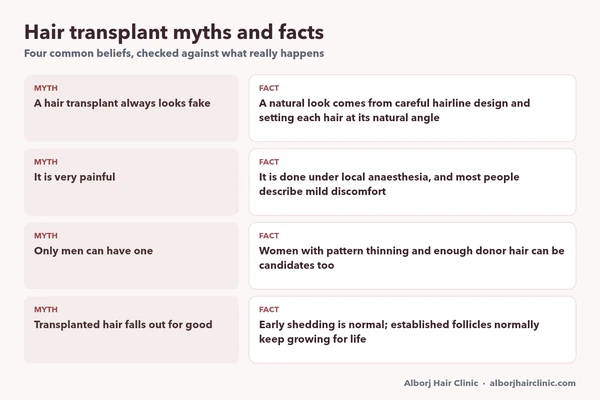
No. An obvious result usually comes from poor planning, not from the transplant itself.
The surgeon designs a hairline to suit your face and age. Each hair is then set at the angle and direction it would naturally grow, so the new hair blends with your own.
Some of the unnatural results people remember came from older methods that moved hair in larger clumps. Today, hair is moved as follicular units, the small natural groups of about two to four hairs that grow together.
With DHI (Direct Hair Implantation), each follicle is placed by hand with an implanter pen. This lets the surgeon decide exactly where every hair sits and which way it points.
Density matters as well. A hairline that is too thick right at the edge can look as unnatural as a sparse one. That is why the front is usually kept soft.
Is a hair transplant very painful?
For most people, no. Because the work is done under local anaesthesia, most patients describe it as mild discomfort, with little or no pain.
The numbing injections are usually the part people notice most. Once the area is numb, many patients listen to music, watch something or simply rest while the surgeon works.
Afterwards, the scalp may feel tight or tender for a few days. There are no stitches with DHI, because follicles are removed one by one with fine punches. Your clinic will explain how to manage any soreness.
If you are anxious about discomfort, say so at the consultation. Knowing what each stage feels like often makes the day itself much easier.
Can only men have a hair transplant?
No. Women can be candidates too, if their thinning follows a pattern and they have enough healthy donor hair.
Female pattern thinning tends to look different from male hair loss. It often shows as a widening parting or thinning on top and is graded on the Ludwig scale, which has three grades. Men’s hair loss is graded on the Norwood scale.
Thinning in women is not always pattern loss, though. Hormonal changes, illness and other factors can play a part, so a proper assessment comes before any talk of surgery.
Will you see the results straight away?
No, and this myth causes more worry after surgery than any other. In the first few weeks, transplanted hairs often shed, which is expected and does not mean the follicles have been lost.
New hair usually begins to grow at around three months. It then lengthens and thickens over the following months, and the full result shows at around 12 months.
This matters if you have a wedding or another big event coming up. Planning the procedure about a year ahead gives the new hair time to grow in.
“I tell patients that the first months are a waiting game. The shedding is normal, and the new hair arrives gradually. We judge the result at around a year, not in the first few weeks.”
Do you have to shave your whole head?
Not always. Because follicles are taken out one by one, the donor area often needs to be trimmed short. This lets the surgeon see and reach each one.
How much of the rest is shaved depends on the size of the treated area and the plan for your case. Your surgeon will explain this at the consultation, so there are no surprises on the day.
If you are worried about how you will look in the first weeks, raise it early. Knowing the plan helps you time the procedure around work and social events.
Trimmed hair grows back, so the shorter look is a passing stage. Many people find a simple cap or a short, tidy cut helps while it does, once their surgeon says a cap is fine.
Will the transplanted hair fall out again?
The early shedding is temporary. Transplanted hair comes from areas where hair tends to resist thinning. After they settle, those follicles normally carry on growing for life.
What can change is the hair around them. Your own non-transplanted hair may keep thinning over the years, so a careful surgeon designs the result with that in mind.
This is also why donor hair is treated as a limited supply. A sensible plan uses it with care rather than all at once.
Once it has grown in, transplanted hair can be cut and styled like the rest of your hair. Ask your clinic when it is safe to start colouring or using styling products again.
About Alborj Hair Clinic
Alborj Hair Clinic is a hair transplant clinic in Mazaya Centre, Al Wasl, Dubai. Its surgeon, Dr Dimitrios Ziakas, has 24 years of experience and has performed more than 4,000 hair transplant procedures. He is a member of the International Society of Hair Restoration Surgery (ISHRS) and uses the DHI (Direct Hair Implantation) technique.
Anyone weighing up these myths against reality can look through the before-and-after case studies on the clinic’s website.
Frequently asked questions
Is DHI the same as FUE?
DHI uses the same one-by-one removal of follicles with fine FUE punches. The main difference is placement: in DHI, each follicle goes straight into the thinning area with an implanter pen.
Are there stitches after a hair transplant?
Not with DHI. Follicles are taken out individually with fine punches, so no stitches are needed.
Can a hair transplant fix every type of hair loss?
No. It suits pattern hair loss where there is enough donor hair. Sudden, patchy or widespread loss needs a doctor’s assessment first.
How many hairs are in one graft?
A graft, or follicular unit, usually holds about two to four hairs. That is why the number of grafts and the number of hairs are not the same thing.
